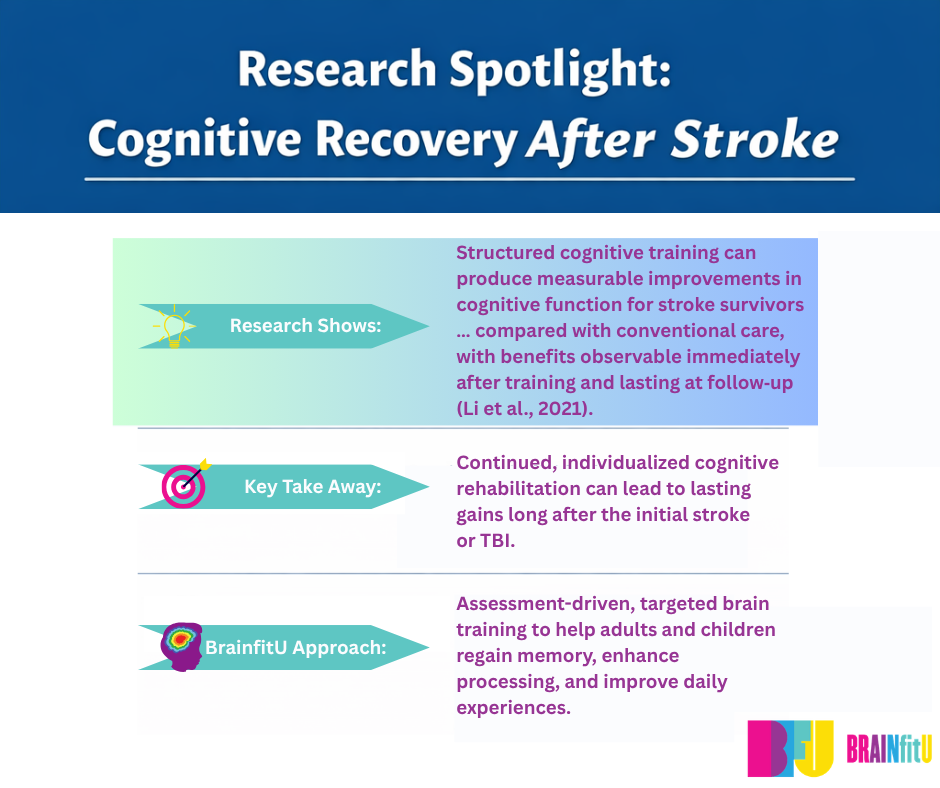
Research shows that structured cognitive training can produce measurable improvements in cognitive function for stroke survivors…cognitive training demonstrated significant gains in global cognition, working memory, attention, and other cognitive domains compared with conventional care, with benefits observable immediately after training and lasting at follow‑up (Li et al., 2021).
These findings highlight the value of continued, individualized cognitive rehabilitation. Programs like those offered at BRAINfitU provide targeted, assessment‑driven training designed to address the specific cognitive challenges adults face after a stroke or TBI. By focusing on the root causes of cognitive deficits rather than generalized exercises, BRAINfitU helps adults regain memory, improve processing, and enhance functional performance in everyday life, supporting long-term recovery and independence. The one-on-one, science-backed brain training is one of a kind in the Stafford, VA area.
BRAINfitU works with adults who experience cognitive decline following neurological injury, including stroke, traumatic brain injury, and spinal cord injury. By identifying the specific cognitive skills limiting daily functioning, BRAINfitU moves beyond generalized activities or repeated practice. Each program begins with a comprehensive cognitive assessment designed to uncover root causes and guide targeted, effective intervention.
The following case example illustrates how individualized cognitive training can support functional improvement and increased independence in an older adult recovering from neurological injury. This case involved a seventy-four-year-old adult male who presented with cognitive deficits following neurological injury. Despite only mild physical impairment, he experienced significant challenges with memory, slowed processing, speech clarity, and difficulty retaining spoken information. These issues affected his ability to follow conversations, remember instructions, and manage everyday tasks.
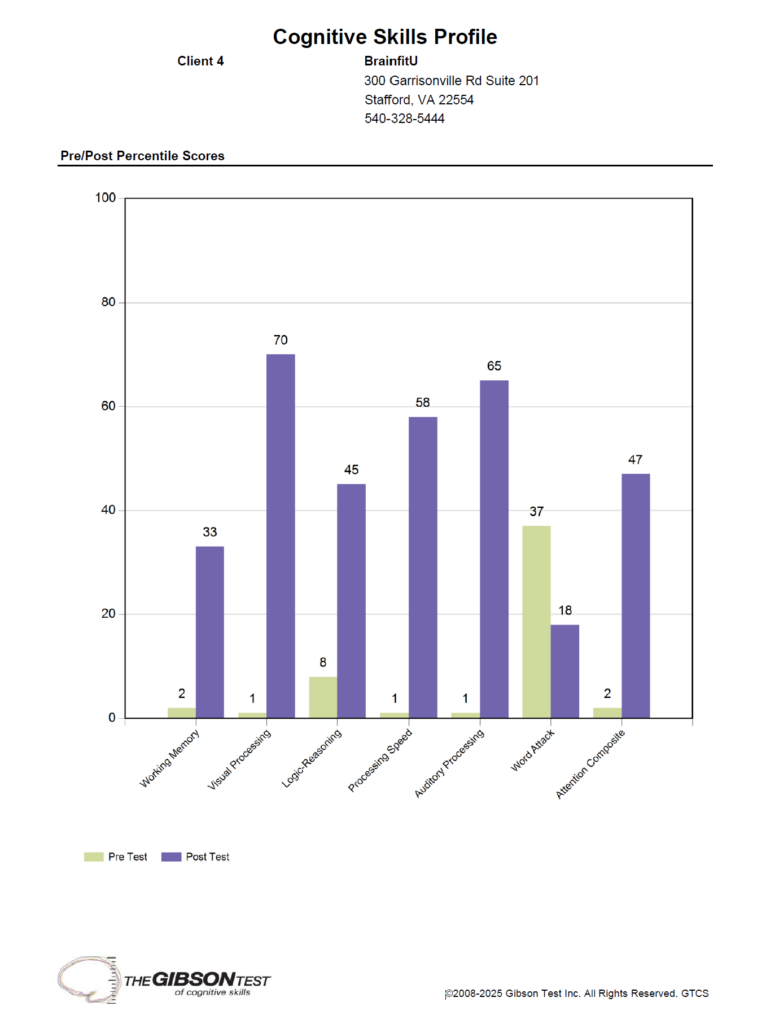
A comprehensive cognitive evaluation was conducted using the Gibson Cognitive Skills Test to assess memory, processing speed, reasoning, and foundational cognitive abilities tied to real-world function. Results revealed severe weaknesses in auditory memory and auditory processing, while visual processing, reasoning, and processing speed were relatively preserved.
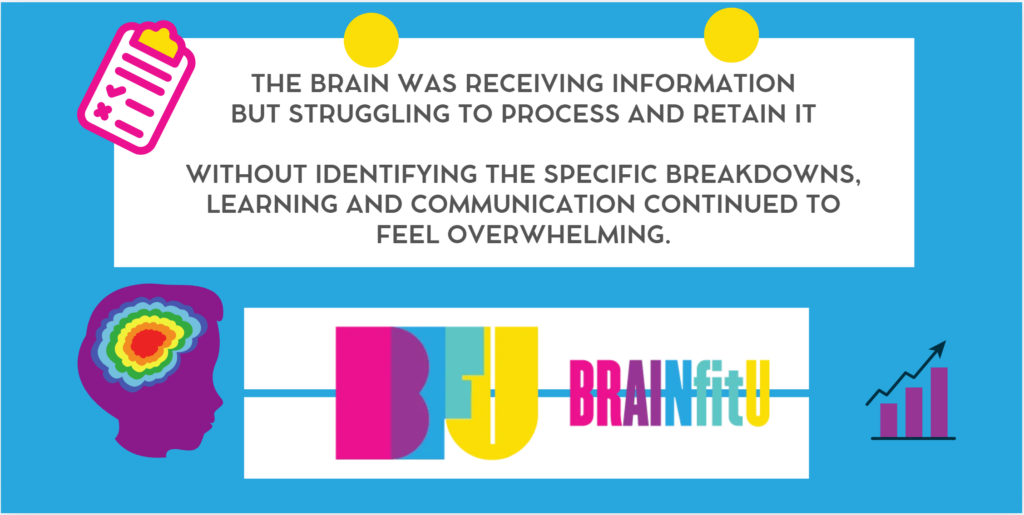
This cognitive profile demonstrated why everyday communication and learning felt overwhelming. The brain was receiving information but struggling to process and retain what was heard. Without identifying these specific breakdowns, progress would likely remain limited regardless of effort or repetition.
Based on assessment findings, a targeted cognitive training plan was developed. The program included one hundred twenty hours of structured training delivered three times per week, combined with guided home exercises to reinforce progress between sessions. The U.S. Department of Health and Human Services National Institutes of Health says that the intensity of a rehabilitation program can affect the outcomes. The specially designed BRAINfitU training focused directly on auditory memory, auditory processing, and integration skills critical for functional communication.
BRAINfitU one-on-one training creates a space where real relationships can grow alongside real progress. Because training is individualized, trainers get to truly know each client, understand their challenges, and recognize their strengths. This personal connection allows trainers to see growth as it happens and celebrate each milestone right alongside the person putting in the work. Throughout training, this client showed a quiet determination to regain skills that had become more challenging after his stroke. With individualized support, the trainer was able to understand his specific struggles, recognize his strengths, and adjust training as progress unfolded.
Over time, improvements that began as numbers on an assessment became meaningful changes in daily life.
•Following conversations became easier
•Information was processed with greater confidence
•Small victories reinforced his motivation to keep going
Each milestone represented more than cognitive improvement. It reflected a growing ability to reconnect with conversations, daily activities, and a greater sense of independence, with his trainer supporting and encouraging him every step of the way.
Post-training evaluation showed meaningful improvement across nearly all domains, as shown in Chart 1A below. Auditory memory improved from very low to below average, going up by 35 percentage points; auditory processing increased into the high range, improving by 87 percentage points, and visual processing advanced to above average, with a 68 percentage point improvement. Logic, reasoning, and processing speed were maintained within the average range, increasing by 51 and 55 percentage points, respectively. These gains reflected not only improved test performance but also enhanced functional capacity in daily life.
This case illustrates a critical truth in adult cognitive rehabilitation. Lasting improvement requires identifying and addressing the exact skills that are impaired. When training targets the root cause rather than the symptom, adults with cognitive delays from stroke injury, TBI, or SCI can experience real recovery rather than compensation alone.
BRAINfitU uses science and research-backed processes to guide every recommendation. When cognitive training is appropriate, it is delivered with precision and purpose. When other supports are needed, referrals are made to ensure individuals receive the right care rather than continuing ineffective intervention. BRAINfitU is happy to work alongside other professionals to get the best results for the individual.
Cognitive challenges after TBI or SCI do not have to be accepted as permanent. With individualized assessment, targeted training, and consistent follow-through, adults can rebuild cognitive efficiency, restore confidence, and improve daily functioning at any stage of life.
If you or a loved one is experiencing lingering cognitive changes after a stroke, TBI, or SCI, BrainfitU can help identify what is holding progress back and create a clear path forward. To learn more about our assessment-driven approach and adult brain training services, contact BrainfitU at 540-328-5444 or visit brainfitu.com to schedule a free consultation.
References
Li, Y., Chen, Q., & Wang, T. (2021). Effects of computerized cognitive training on cognitive function, activity, and participation in individuals with stroke: A randomized controlled trial. PubMed.https://pubmed.ncbi.nlm.nih.gov/35311716/
National Institute of Neurological Disorders and Stroke. (2025). Post stroke rehabilitation. National Institutes of Health. https://www.ninds.nih.gov/sites/default/files/2025-05/post-stroke-rehabilitation.pdf
Real progress begins when you understand the whole picture. Reach out today to take the first step toward lasting change.
Learn more or schedule an assessment at brainfitu.com
Contact BRAINfitU today 540-328-5444!
Like us on Facebook!
Follow us on LinkedIn!
Book a Complimentary Phone Consultation today!